

Weekly Bulletin


 | Bookmark This Page


FREE E-Bulletins
Free HealthTips & Advice
Email


Digg!


Eight Ways to Eat Like a Native

Daphne Miller, M.D., traveled the world to find the components of traditional diets that are both delicious and healthy. From Iceland to Crete to the Amazon basin, the San-Francisco-based physician studied indigenous populations that are largely free of diabetes, obesity, coronary artery disease, Alzheimer’s disease and other common medical concerns of the developed world. While the diets she analyzed seemed quite varied - Icelanders eat fish and few vegetables, while the Tarahumara Indians of rural northern Mexico eat corn and squash - she did find several unifying characteristics that we would all do well to emulate in our own diets:

  1. The foods are local, fresh and unprocessed.
  2. Animals that are consumed have also “eaten well,” from fresh, local ingredients.
  3. Meat and dairy are eaten in small quantities within a larger meal.
  4. Processed grains and sugars are eaten rarely.
  5. Healing spices such as turmeric and ginger are used in many dishes.
  6. Fermented foods are consumed often.
  7. People rarely eat alone.
  8. Feasting is confined to special holidays, unlike American culture, in which “we have what amounts to a feast every day,” said Dr. Miller.

I highly recommend Dr. Miller’s book, The Jungle Effect: A Doctor Discovers the Healthiest Diets from Around the World - Why They Work and How to Bring Them Home. It includes recipes based on the traditional diets she studied, yet that can be made with ingredients easily available in modern America. For more details, here is an interview with Dr. Miller.

Eat Healthy - For Life!
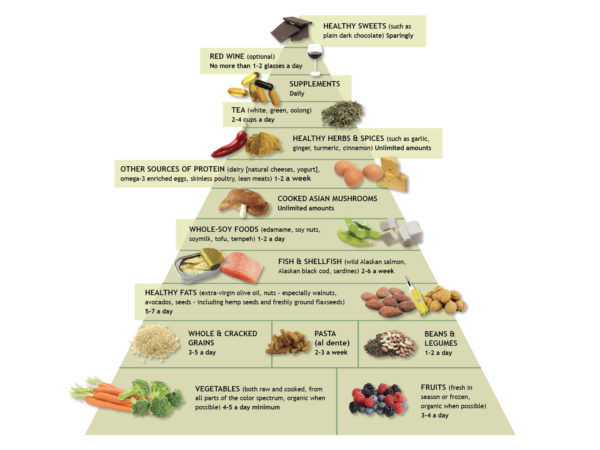
The anti-inflammatory diet on Dr. Weil on Healthy Aging makes eating healthy - and enjoying your meals - simple and satisfying. Sign up today and save $10 - use promo code: ha10off


Vitamin D to Prevent Heart Attacks

advertisement
Men who are deficient in vitamin D appear to have a higher risk of heart attacks than men whose blood levels of “D” are adequate. These findings come from a review of medical records and blood samples of 454 men between the ages of 40 and 75 who had fatal or nonfatal heart attacks between January 1993 and January 2004 compared with 900 men who had no history of cardiovascular disease. The vitamin D connection remained significant even after researchers adjusted for such heart disease risk factors as family history of heart attacks, body mass index, alcohol consumption, physical activities, diabetes, high blood pressure, cholesterol levels, omega 3 intake and ethnicity. The study was conducted by researchers at the Harvard School of Public Health and Brigham and Women’s Hospital in Boston. The results suggest that current recommendations for vitamin D intake need to be increased to boost blood levels of “D” high enough to benefit health, the authors said. The study showed that men whose blood levels of vitamin D were 15 nanograms per milliliter or less were at increased risk. Sufficient blood levels of “D” were 30 nanograms per milliliter or more.

Are You Getting Enough Vitamin D?
Find out - get your free, personal supplement recommendation from Dr. Weil’s Vitamin Advisor.Make your first purchase in June and get free shipping!


Exercises to Beat Workplace Pain
Does your job give you a headache? Or do your neck and shoulders ache after a few hours at work? Some simple exercises could help, Italian researchers reported after testing them on 192 government office workers. The investigators taught the employees to recognize the origin of tension-generated pain: contracting muscles in the face, neck and shoulders. One of the actual exercises involved standing with heels, hips and nape of the neck touching a wall, then repeatedly rolling the shoulders back to the touch the wall and then releasing them forward again. Another required standing against a wall and slowly turning the head from side-to-side. The office workers also learned a relaxation exercise to perform at home daily: sit in a comfortable chair in a quiet room for 10 to 15 minutes, with warm pads on the shoulders and cheeks. The researchers reported that over eight months, headache frequency dropped by 41 percent and neck and shoulder pain frequency fell 43 percent. The study was reported in the May 2008 issue of Cephalgia.

Looking for Exercise Tips?
From yoga to T’ai chi, Dr. Weil’s My Optimum Health Plan covers gentle exercises that can help promote a healthy body and mind. Learn more - visit today and take the free tour!


Barley Salad
This summer salad combines barley, a satisfying, nutty grain, with fresh vegetables. Flavored with mint, parsley, garlic and lemon, it might remind you of tabbouleh, a Middle Eastern dish traditionally made with bulghur wheat. Barley has one of the lowest glycemic loads of any grain, and parsley has carminative (intestinal gas-relieving) and diuretic properties, making it an excellent tonic ingredient. Look for the flat-leaf (Italian) parsley, which has a more pronounced flavor than the curly leaf variety. This dish makes a healthy alternative to the usual picnic or potluck potato salad. Try it as a light meal all on its own, or as a wonderful accompaniment to other dishes.
View Recipe

Healthy Aging Tip
Courtesy of Dr. Weil on Healthy Aging
Seasonal Foods: Watermelon. Providing healthy doses of vitamins C, A, B1 and B6, watermelon is a low-calorie, antioxidant-rich treat. It is particularly healthy for men: it is a good source of the carotenoid lycopene, which has been shown to help reduce the risk of prostate and other cancers. Try spicing it up and add some black or crushed red pepper to sliced watermelon.


Featured Discussion:
“Can you recommend a good mattress?” asks gammalexicon.
(My husband and I)…are in the market for a mattress, and although our budget is small, I am concerned about the flame resistant chemicals that apparently all mattresses are treated with. Does anybody … have any suggestions regarding an economical non-synthetic or non-chemically treated mattress?


Sponsor
RESPeRATE
Try RESPeRATE
- the world's first and only NON-DRUG medical device clinically proven to lower your blood pressure. Best of all = No side effects.


What’s New
Integrative Medicine at Hollyhock
Hollyhock Retreat, Cortes Island, British Columbia, Canada, June 20 - 25, 2008
Embrace a new healing-oriented approach to medicine that takes into account the whole person, including all aspects of lifestyle. The program in Integrative Medicine emphasizes the therapeutic relationship and encompasses both conventional and alternative therapies. This is a unique opportunity to study with leading doctors from this internationally recognized Arizona Center for Integrative Medicine at the University of Arizona. Learn integrative strategies that promote health and well-being. Featuring Dave Kiefer, M.D., Andrew Weil, M.D., Esther Konigsberg, M.D. and Raffaele Filice, M.D. Visit www.hollyhock.ca for more information and to register.

FEATURED PRODUCTS

advertisement
 
Copyright © 2009 Weil Lifestyle, LLC
Information on this web site is provided for informational purposes only and is not intended as a substitute for the advice provided by your physician or other healthcare professional. You should not use the information on this web site for diagnosing or treating a health problem or disease, or prescribing any medication or other treatment.